
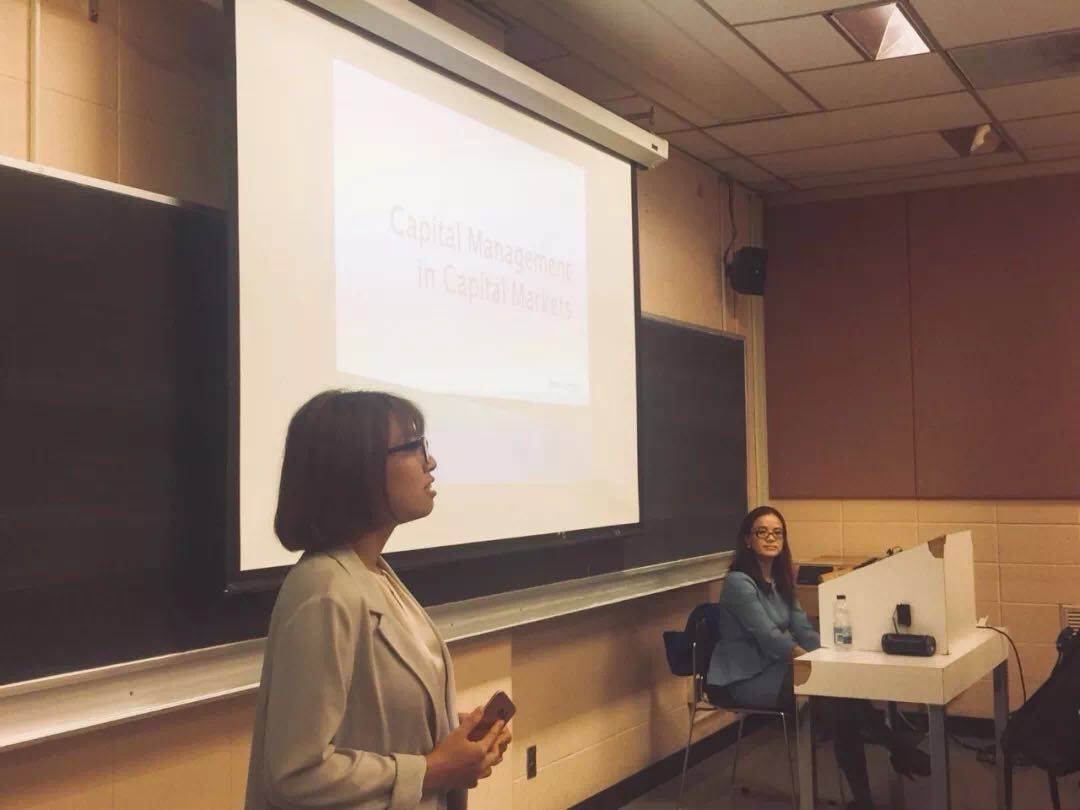
On June 27th, 2018, New Horizon Career Club (NHC) held the first seminar regarding the topic of capital management in Capital Markets and Commercial Banking. The speaker, Jenny Ding, provided a thorough overview on the development of regulatory requirements imposed on the banks, and the challenges on capital optimization.
– Part 1. Definition of Capital –
Mrs. Ding (Vice President, Global Trade & Banking, BMO Capital Markets) first introduced the concept of capital from the bankers’ perspective. The capital is defined as a Safe Net for maximum potential loss the bank might suffer while carrying on risk-taking activities within one year. Therefore, it becomes essential for banks to hold required capital to minimize the negative exposure in the event of a significant financial loss.
 The capital demand is the required amount of capital derived from enterprise’s risk-taking activities. Risk-Weighted Asset (RWA) is the capital demand which used to determine the amount of capital thatmust be available.
The battle between financial institutions and regulators has always come down to the amount of reserve that banks need to hold available. The profit-driven banks intend to achieve the maximum returns by utilizing every penny they have in the pocket. However, the opposite side is right for the regulators to ask for banks to hold as much capital as possible to keep the system stable.
– Part 2. Types of risk –
The primary focus on this topic is to highlight the types of risks associated with holding capital. The main risks are the credit risk, market risk and operational risk. The credit risk is the loss due to the failure of a borrower to honor the financial obligation; the market risk is the downward pressure on the value of financial assets due to market condition; the operational risk is the loss resulted from failed internal processes and human interaction. The classical example would be the Jérôme Kerviel case in 2008, one single illegal trade triggered 7 billion dollar loss due to the failure of internal processing. Last but not least, the model risk may cause potential damage due to poorly built models or inappropriate use of the model.
– Part 3. Brief History of Basel Results –
The downfall of Basel I: Under RWA calculation, all corporate is weighted 100% regardless of the actual sensational risk ratings of the companies. Disagreement raised by the lenders regarding the indifference of treatments on various types of companies. For example, Jamie and Jenny‘s Pizza shares the exact same treatment on RWA with the AAA-rated Volkswagen. Therefore, Basel I was replaced by Basel II.
The famous ‘Three Pillars’ concept was developed in Basel II to require the bank to hold certain regulatory capital based on its credit and market and operational risk. Basel II also asked the additional regulatory capital for the bank by adding mandatory buffers. For example, Bank with righter credit rating may be required to hold a thicker buffer or capital supply to maintain an excellent credit rating. Last but not least, the enhancements on disclosure requirement became effective in Basel II.
Basel III: All regulatory ratios increased and more restrictive rates added as a result of the aftermaths of 2008 financial crisis.
Basel IV: New rules still in consultation stages and will be implemented in the 2020s.
– Part 4. Risk-adjusted Return on Capital –

The Risk-adjusted return brings up an interesting modern paradox. Regulator wants a higher ratio on capital adequacy via holding more considerable capital, which resulted in lower return ratio. In contrast to regulators, investors demand a higher rate of return if the lower capital amount is applied. Conditional calculation typically solves this situation that optimizing the result by fixing one variable.
Great thanks to Jenny for making this seminar possible and provided valuable insight for our young audience who wish to pursue a career in risk management.
– written by Arthur Chen
Arthur Chen graduated from the University of Toronto Rotman Commerce Accounting Program. He is actively pursuing FRM designation, and currently working as a business analyst at BMO Commercial Performance Management Group.