
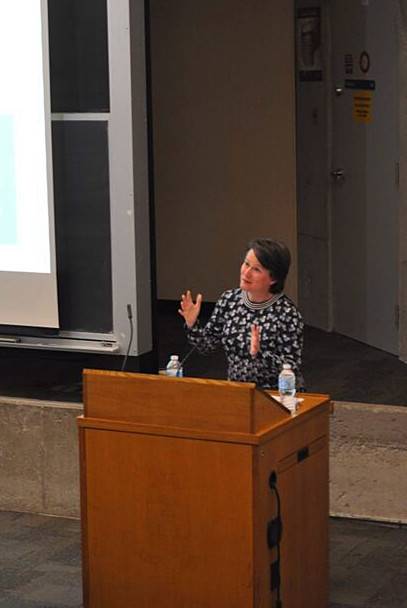
NHC is honored to invite Mrs. Shannon MacDonald, Chief Inclusion Officer and Vice Chair of Deloitte Canada, to give a speech on Deloitte’s diversity and inclusion journey and organizational culture, and to share her own experiences and thoughts on diversity, inclusion, and career development.
TORONTO, June 15, 2015
The presentation consisted of three main topics: the business case for inclusion, Deloitte’s people communities (often referred to as Employee Resource Groups), and Deloitte’s vision to achieve a truly inclusive culture. In addition, MacDonald shared her own stories as a female leader who has been working at Deloitte for 25 years.
What Is Diversity and Inclusion?
In the beginning of the speech, MacDonald defined the two related yet separate concepts: diversity and inclusion. Diversity refers to any uniqueness that can be used to differentiate people from one another. “At Deloitte, it means respect for and appreciation of differences in ethnicity, gender, age, national origin, disability, sexual orientation, education, and religion,” MacDonald said. Inclusion, one word that has been often used by Deloitte, demonstrates more about a feeling of belonging and individual value at an organization.

Why Diversity and Inclusion?
After graduating in 1990, MacDonald started her career at Deloitte and couldn’t help but ask, “Can women have it all?” Today, twice named one of Canada’s Most Powerful Women, she still asks this question, thinking, “Are we diversified? Am I inclusive?” Over the past few decades, the workplace, workforce, and customers have been dramatically changing like never before. An interesting fact is that research shows that customers of different ethnicity are much more satisfied with the services provided by people of the same ethnicity. Furthermore, findings from a recent Bersin report show that developing inclusive work environments and leadership teams have been shown to drive strong organizational performance. Therefore, D&I needs to be deployed and rooted into every single function of an organization, from practitioners to board of directors.
Covering
MacDonald explained four types of covering, including appearance-based, affiliation-based, advocacy-based, and association-based covering. One typical affiliation-based covering example would be saying, “I avoid talking about being a mother, because I don’t want my colleagues to think I am less committed to work.” People try to fit in, and they tend to cover themselves. However, the vast majority agree that covering is detrimental to their sense of self and the inclusion state at the workplace. “Females at work need to maintain who they really are, as a mother, a wife, and a leader,” Macdonald said.
Deloitte’s Vision
“At Deloitte, our vision is to lead by building a culture through commitment and mutual accountability. A culture where all our people feel like they belong, feel free to live and work openly and understand that inclusion is core who we are,” MacDonald said. And Deloitte’s Diversity and Inclusion journey is the key to achieving this vision.
Deloitte has experienced a shift in culture where everyone becomes part of the problem and solution, and the company has made significant progress to integrate inclusion into their leadership culture. At Deloitte, it’s believed that working with people of different backgrounds, cultures, and thinking styles helps employees grow into better professionals and leaders. To continue harnessing an inclusive culture, Deloitte Canada has made every effort to be the first professional services firm to reflect the Canadian population, at all levels of the organization. “At Deloitte, things were fairer because of more diversity,” explained MacDonald.
Deloitte Communities
While 50% of Canadian organizations do not utilize any Employee Resource Groups (ERGs), there have been eight formal Deloitte communities to jump starting its diversity and inclusion practices.
Currently Deloitte communities include:
- LEAD & Allies Inclusion Network – Deloitte Canada’s Lesbian, Gay, Bisexual, Transgendered, Queer and Allies (LGBTQA) community
- Canadian Asian Network (CAN)
- Canadian Black Professional Network (CBPN)
- Canadian Women’s Initiative (canWin)
- Deloitte Dads
- Deloitte Aboriginal and Allies Community
- Access Ability Community
- Boomer Network
Deloitte communities bring together people to build connections, open up opportunities to everyone at the firm at all levels and services, and offer employees professional and personal support.
Take the Canadian Asian Network (CAN) as an example, this community seeks to enhance Asian cultural awareness and address specific cultural challenges facing Deloitte professionals of Asian descent. MacDonald explained, “This community provides opportunities to Asian employees to network, communicate with senior management and build meaningful relationships with external partners and the Asian community at large.”
CAN’s recent events and initiatives included celebrating Chinese Mid-Autumn Festival, providing adhoc staff and support for all Asian cultural queries, and collaborating with Asian networks from various channels.
On-site Interview and Q&A
During the final session, MacDonald received questions from various perspectives from the host – Miss Lea Zhu and the audience, and shared her thoughts and suggestions on questions such as:
- What are you looking for from a fresh graduate, beside the necessary skill sets, that make you think this person is a great fit for Deloitte?
- How would you say your formula of success as a female role model, and what keeps you moving forward in Deloitte for 25 years?
- What’s your point of view on the so called “glass ceiling” for visible minorities?
- How do you plan a career path for women while balancing your job and family?
- What do you think about a stereotype of Chinese employees who are considered as hard-working, considerate, or even tolerant and not speaking up enough? How to help this type of employees improve themselves?
- How do you develop yourself personally to become a leader?
- How would you suggest Chinese new immigrants to better fit into a local company and use their comparable advantages in the workplace?
It’s worth mentioning that MacDonald emphasized that for young professionals, it’s not only about being flexible and being involved in a team, but it’s also essential to be able to work with different kinds of people with different backgrounds and mindsets. It’s important to put yourself into other people’s shoes and always appreciate and accept the difficulties each individual may have, and transfer it in your team to solve the problem. Specifically, MacDonald encouraged the Chinese attendees to utilize the most of their skills and personalities, and to break the ‘glass ceiling’ in their workplace.
Besides, employees at Deloitte are expected to keep learning, and to have the push to help people around you with an open work style. “Young professionals at first learn from the pioneers, and then they start pioneering and influencing others.” In addition, MacDonald used her own experiences and pointed out that during a meeting, you should always do more than just observing. “Just say something, make a comment, and your leadership is based on you saying something. Think about a meeting as an opportunity to show your talent and engagement.”